


Computerised Glass Bevel : The Complete Guide to Precision-Cut Edges
If you've ever run your hand along the edge of a beautifully finished mirror or a glass tabletop and felt that smooth, angled slope instead of a sharp corner, you've touched a Computerised Glass Bevel. It's a small design detail that makes a big difference — in safety, in light, and in how "finished" a piece of glass actually looks.
At A Touch of Glass, we've been processing architectural and decorative glass in Navi Mumbai since 2005. Under the guidance of Mr. Faisal Gandhi, who brings over 20 years of hands-on experience in the glass industry, we run our own Computerised Edge Polish and Bevel machines in-house — which means every bevel we cut is checked, controlled, and finished under one roof, not outsourced in stages.
In this guide, we'll walk you through what Computerised Glass Bevel actually is, how it's made, where it's used, what it costs to get right (and wrong), and how to choose a fabricator you can trust with your glass.
What Is Computerised Glass Bevel ?
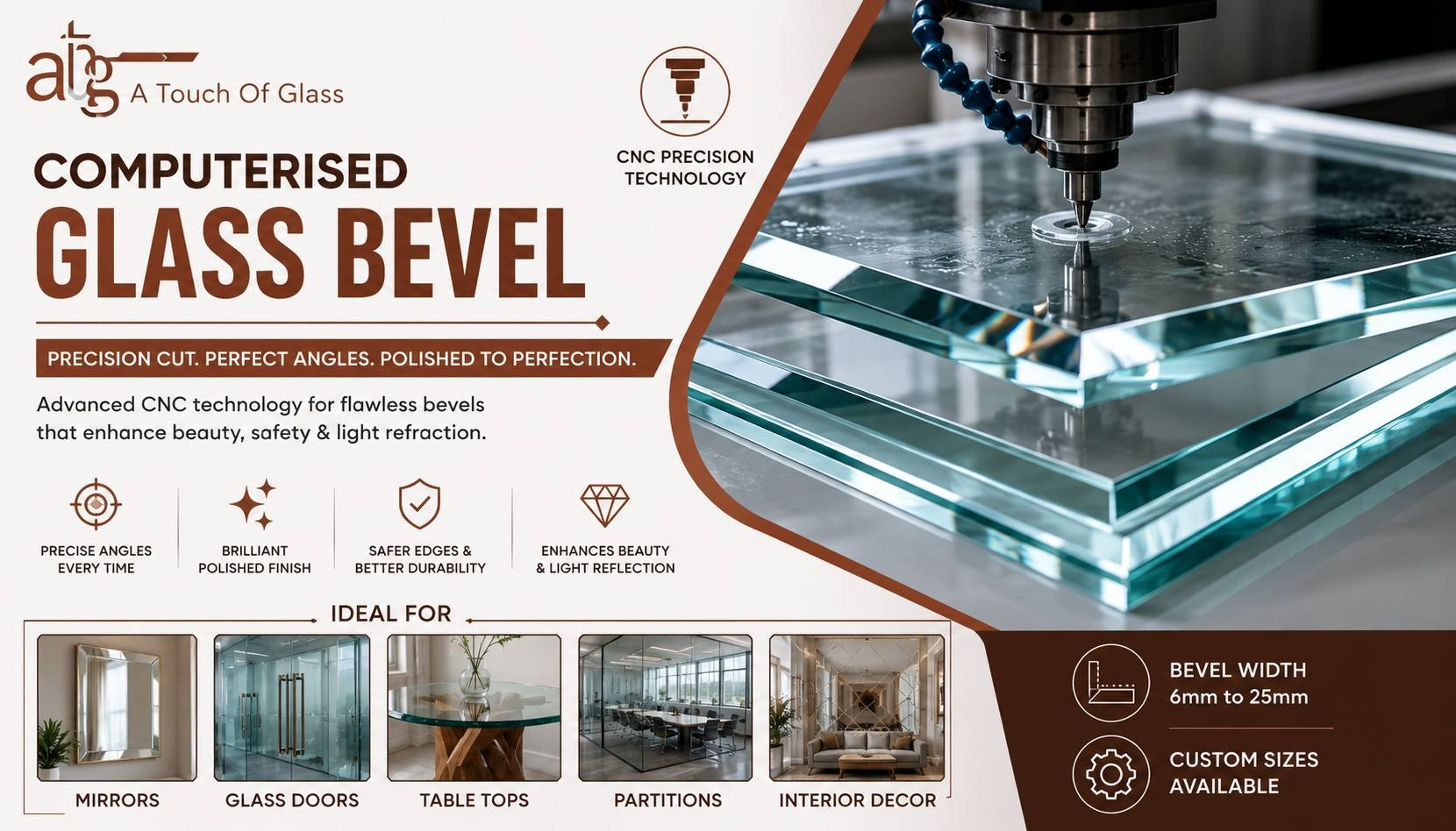
Computerised Glass Bevel is an angled, polished edge cut into flat glass using CNC (Computer Numerical Control) machinery. Instead of a flat 90-degree edge, the glass surface slopes inward at a controlled angle — usually between 6mm and 25mm wide — creating a faceted border that catches and refracts light.
Unlike manual beveling, which depends entirely on an operator's hand and experience, computerised beveling uses programmed grinding wheels and polishing heads to repeat the exact same angle, width, and finish on every single panel. That consistency is the whole point.
How Is It Different from Manual Beveling ?
Manual beveling is still used for small, artisanal, or highly custom decorative work — think stained-glass-style panels. But for architectural glass, furniture glass, mirrors, and any project involving more than a handful of pieces, manual work introduces variation: slightly different angles, uneven widths, inconsistent polish. A Computerized Glass Beveling Machine removes that guesswork. Once a program is set, every panel that runs through it comes out identical.
How the Computerised Beveling Process Works ?
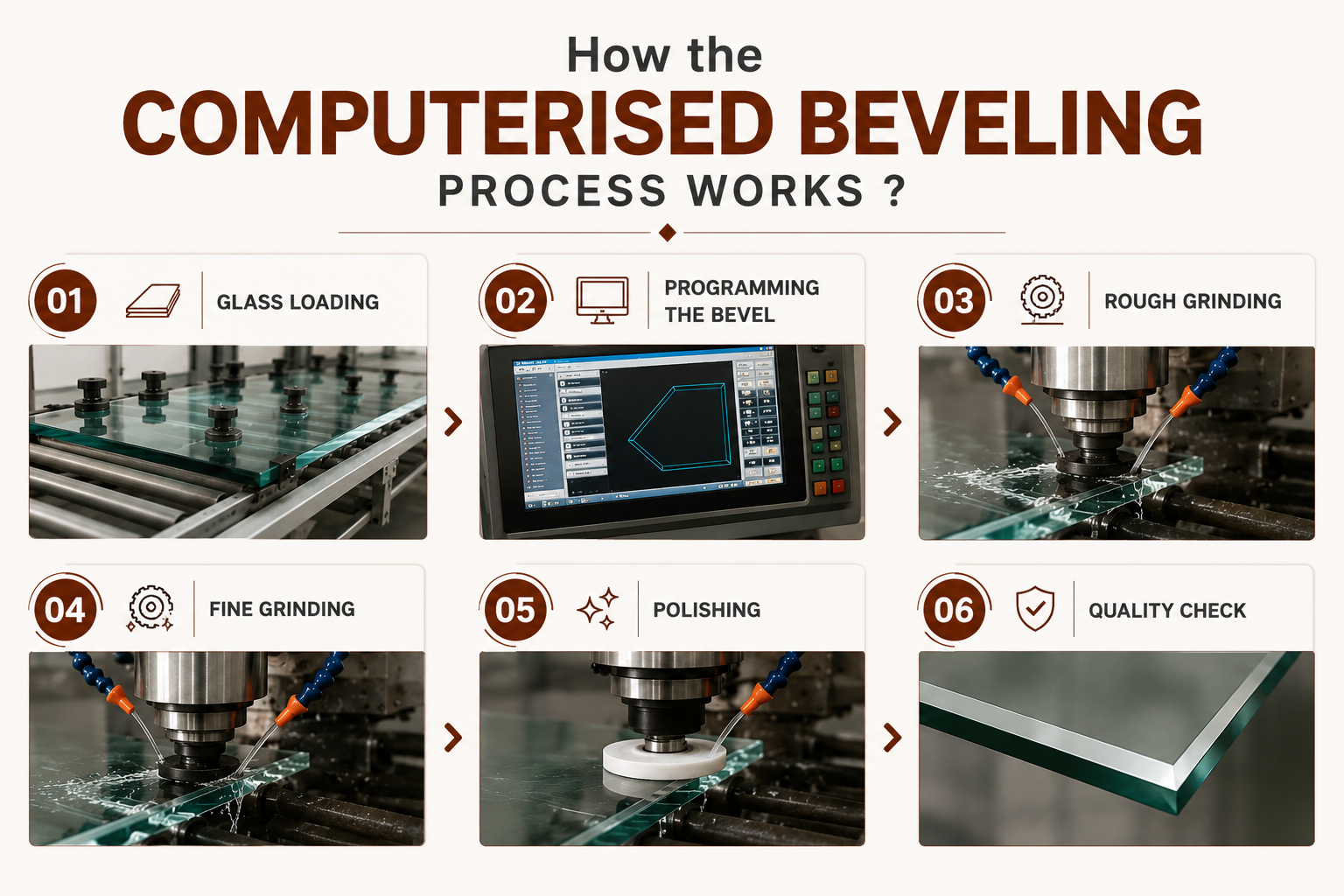
Here's a simplified step-by-step look at how a bevel actually gets made on an Automatic Glass Beveling Machine :
- Glass loading - The float glass sheet (commonly Saint Gobain, Modiguard, or HNG glass) is loaded onto the machine bed and secured.
- Programming the bevel - The machine is set for bevel width, angle, and edge profile based on the project's design specification.
- Rough grinding - Diamond or abrasive wheels remove material along the edge to create the angled slope.
- Fine grinding - A second pass smooths out grind marks and refines the angle.
- Polishing - A glass polishing machine stage buffs the bevel to a clear, glossy, scratch-free finish.
- Quality check - Each piece is inspected for angle consistency, edge clarity, and surface finish before dispatch.
This entire sequence is what separates a professional bevel from a rough, DIY-style edge — and it's why precision glass beveling is treated as a craft, not just a machine setting.
Why Computerised Glass Bevel Matters (Beyond Looks) ?
Enhanced Aesthetics
A bevelled edge isn't flat — it's a mini prism. As light hits the slope, it refracts and throws soft highlights along the border of the glass. This is why beveled mirrors, tabletops, and glass partitions feel noticeably more premium than plain-cut glass.
Precision and Consistency
When you're ordering glass for multiple doors, windows, or an entire office partition system, uniformity matters. A Computerized Glass Beveling Machine guarantees that panel #1 and panel #50 match exactly — something manual grinding simply can't promise at scale.
Safety
Sharp, unfinished glass edges are a genuine injury risk — in homes, showrooms, schools, and offices. Beveling removes that sharp corner and distributes stress more evenly across the edge, which also makes the glass somewhat more resistant to chipping during handling and installation.
Design Flexibility
Bevel width, angle, and edge style can all be customised. A slim 6mm bevel reads modern and understated; a bolder 20–25mm bevel reads formal and traditional. This flexibility is why architects and interior designers specify different bevel profiles for different rooms within the same project.
Where Computerised Glass Bevel Is Used ?
| Application | Why Beveling Helps |
|---|---|
| 🪞Mirrors | Adds a decorative frame effect without extra hardware. |
| 🚪Doors & Windows | Refracts light, softens sharp glass edges. |
| 🪑Tabletops & Furniture | Elegant, tactile finish; reduces chip risk on high-use surfaces. |
| 🏢Partitions & Office Panels | Clean, corporate finish with consistent detailing across large runs. |
| 📋Glass Signage | High-end presentation for premium branding. |
| 🏗️Facades & Curtain Walls | Enhances light interaction on large architectural glass installations. |
Beveling is now common across both residential and commercial-architectural glass, precisely because it solves an aesthetic problem and a safety problem at the same time.
Computerised Glass Bevel vs. Standard Edge Polish
People often ask us whether they need a bevel or a plain polished edge. Here's the short answer :
- Choose a polished edge for a minimal, seamless, invisible-edge look — common in modern shower enclosures or glass railings.
- Choose a bevel when you want the edge itself to be a visible design feature — mirrors, tabletops, decorative doors, signage.
Both processes rely on precision edge polish machinery, but the end result — and the visual language it creates — is quite different.
Common Mistakes We See in Beveled Glass Projects
Having processed glass for two decades, a few recurring issues stand out :
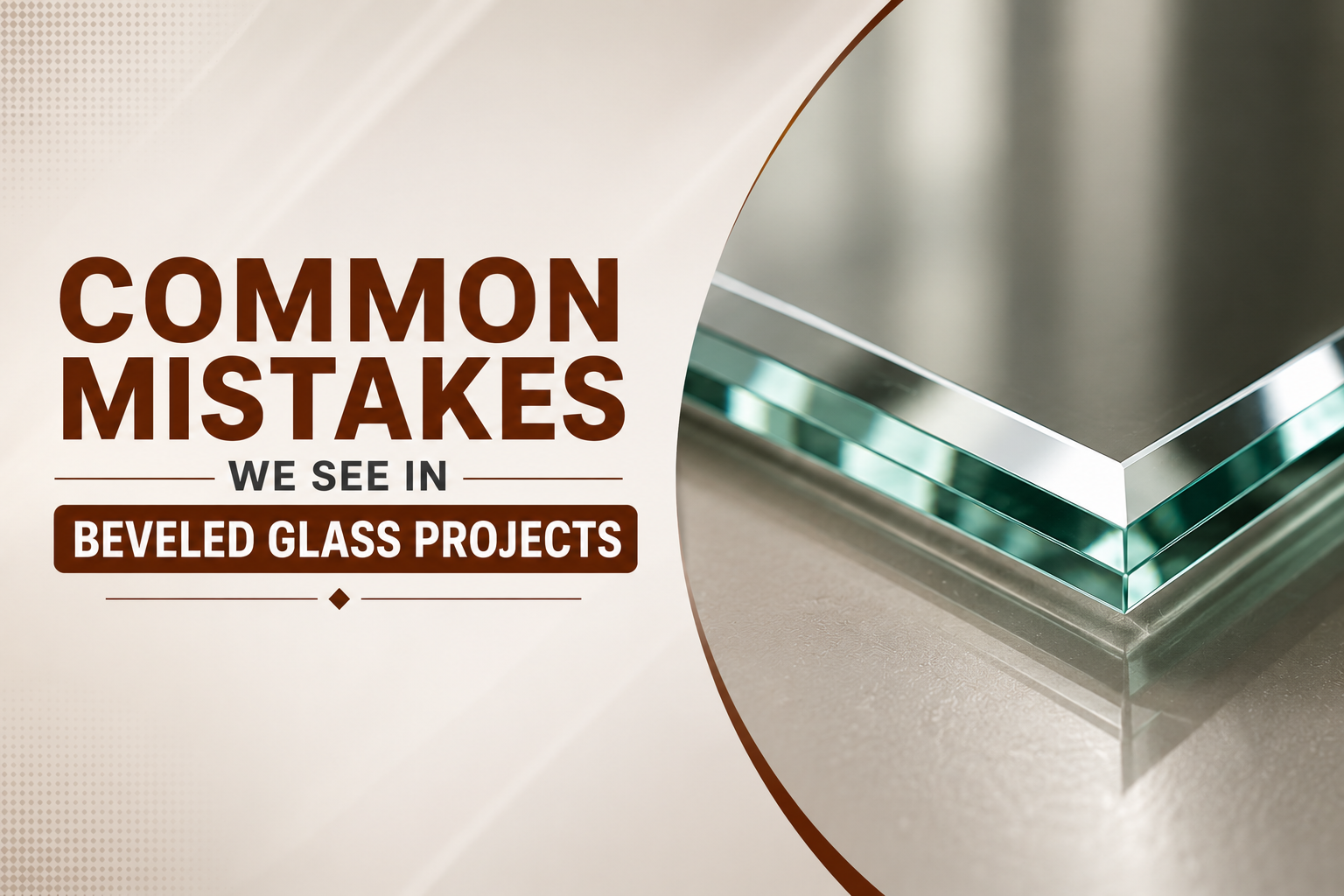
- Choosing bevel width without seeing a sample. A 6mm bevel and a 25mm bevel look completely different in real light — always ask for a physical sample before committing to a full order.
- Ignoring glass thickness. Bevels generally need glass that's thick enough to hold the angle cleanly; very thin glass can look and perform poorly once bevelled.
- Mixing bevel widths across one project. Inconsistent widths across mirrors or partitions in the same space look unfinished, even if each individual piece is well made.
- Skipping quality inspection. Not every fabricator checks angle consistency piece-by-piece — this is where in-house Computerised Edge Polish control makes a real difference.
Why Choose A Touch of Glass for Computerised Glass Bevel ?
We're not a broker who outsources your glass to three different vendors. At A Touch of Glass, based in Kopar Khairane, Navi Mumbai :
- • We operate our own Computerised Edge Polish and Bevel machinery in-house
- • We are stockists for Saint Gobain, Modiguard, and HNG float glass brands
- • We've been in architectural glass processing since 2005, led by Mr. Faisal Gandhi with 20 years of industry expertise
- • We offer custom bevel widths and angles matched to your design brief
- • We provide transparent pricing and realistic delivery timelines
- • We also offer Computerised Glass V-Groove and Computerised Glass Edge Polish services, so your entire glass finishing needs can be handled under one roof
Whether you're an architect specifying glass for a commercial fit-out, a contractor sourcing mirrors and partitions in bulk, or a homeowner upgrading a single tabletop, our process is built around the same standard: precision first, every single time.
Conclusion : Bevel Your Glass, Elevate Your Space
Computerised Glass Bevel is one of those upgrades that quietly changes how a space feels — safer edges, better light, a more finished look. Getting it right depends less on the concept and more on the execution: the machine, the operator's experience, and the quality checks in between.
If you're planning a project that involves mirrors, doors, partitions, tabletops, or architectural glass panels, A Touch of Glass can help you specify the right bevel width and deliver it with CNC-level consistency.
Frequently Asked Questions
Computerised Glass Bevel is an angled, polished edge cut into flat glass using CNC-controlled machinery. It typically ranges from 6mm to 25mm wide and is used to add a decorative, light-refracting finish to mirrors, doors, tabletops, and partitions.
Cost depends on glass thickness, bevel width, edge length, and order volume. Simple, narrow bevels on standard float glass cost less than wide, custom-angle bevels on thicker glass. Contact A Touch Of Glass for a project-specific quote.
Beveled edges remove the sharp 90-degree corner found on plain-cut glass, reducing the risk of chipping and injury during handling and daily use. For full safety compliance, beveling should still be paired with tempered or laminated glass where required.
A computerised bevel is cut using CNC-programmed machinery, giving identical angle, width, and polish across every panel. Manual bevels depend on an operator's hand and may introduce slight inconsistencies.
Thicker glass generally supports wider bevels and delivers a cleaner finish. Very thin glass may limit bevel width options and affect the final appearance.
A Touch Of Glass, located in Kopar Khairane, Navi Mumbai, provides Computerised Glass Bevel, V-Groove, and Edge Polish services for residential and commercial projects.