


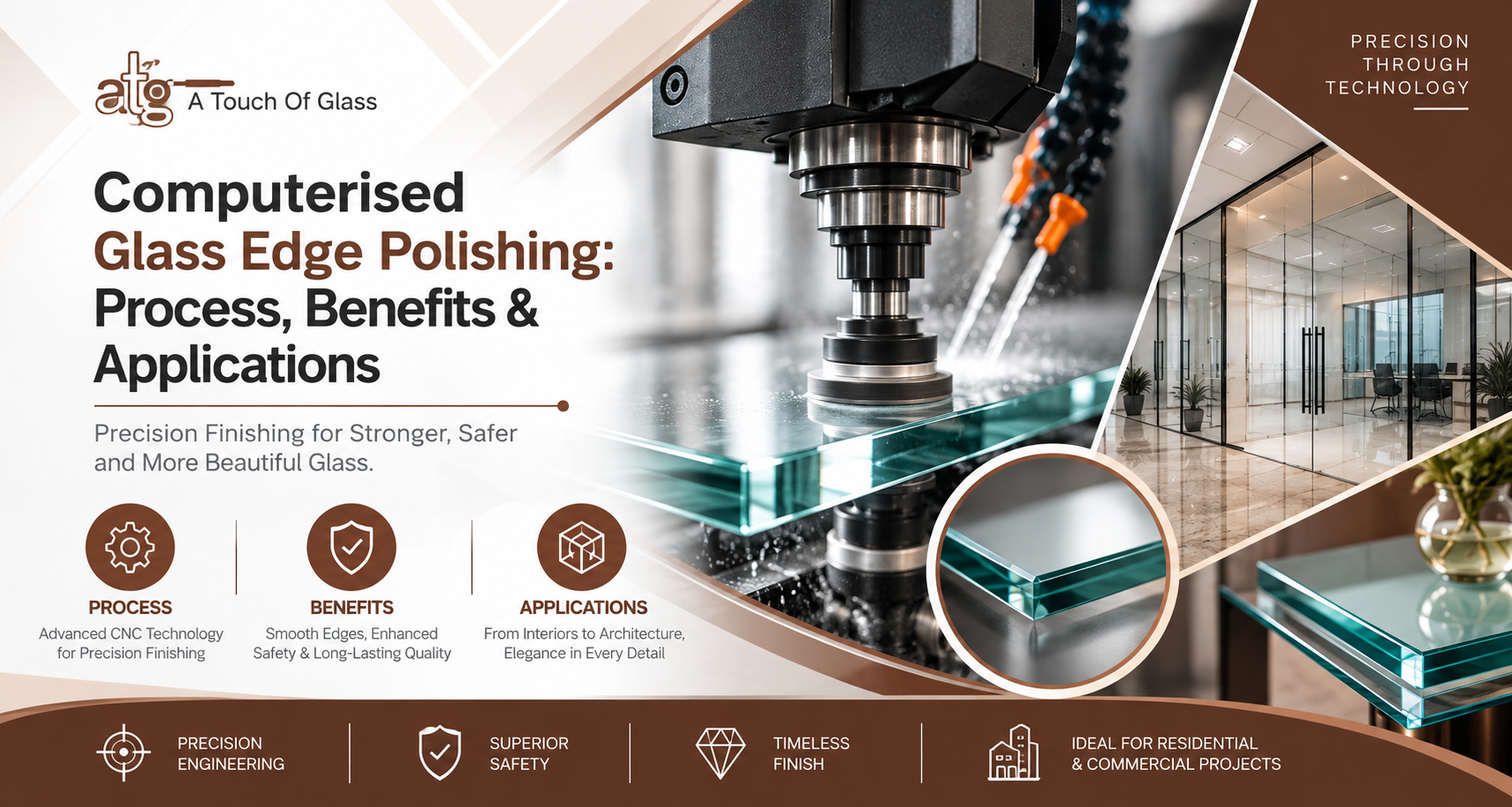
Computerised Glass Edge Polishing: Process, Benefits & Applications
Cut glass doesn't come out of the factory ready to use. Every panel, straight off the cutting table, has rough, sharp, sometimes uneven edges that need to be dealt with before that glass ever touches a home, office, or storefront. That's the job Computerised Glass Edge Polish does — and it's a step we've watched too many people underestimate until something goes wrong.
We've been fabricating and finishing glass since 2005, and if there's one thing two decades on the shop floor has taught us, it's this: edge quality is where most glass problems either get solved or get built in. A well-polished edge protects the glass, protects the people handling it, and quietly signals quality the moment someone runs a hand along it.
This guide breaks down what computerised glass edge polishing actually involves, how the process works step by step, what edge styles exist, what drives the cost, and the questions we hear most often from architects, designers, and homeowners.
What Is Computerised Glass Edge Polish?
Computerised Glass Edge Polish is a CNC-driven process that smooths and polishes the raw, cut edges of a glass panel using diamond abrasives and high-speed automated machines. Instead of a technician manually grinding each edge by hand, the machine controls speed, pressure, and pass sequence, producing a consistent, glossy, glass-like edge free of sharpness, burrs, or micro-chips.
This is different from beveling, which angles the edge for a decorative look — edge polishing focuses primarily on smoothness and safety, though the two are often combined on the same panel.
Why Raw Glass Edges Are a Problem
A freshly cut glass edge is one of the sharpest surfaces you'll encounter in a workshop or on-site. Left untreated, it can:
- Cause deep cuts during handling, transport, or installation
- Develop micro-cracks that spread under stress or thermal changes over time
- Chip easily at the corners, weakening the panel
- Look unfinished and cloudy compared to a polished edge
Computerised glass edge polishing solves all four issues in a single automated process, which is exactly why it's become standard practice for any glass destined for furniture, partitions, or public spaces.
The Computerised Glass Edge Polishing Process, Step by Step
Here's what a professional glass edging process actually looks like from raw panel to finished product:
- Edge inspection — The cut edge is checked for chips, thickness inconsistency, or fractures before polishing begins.
- Edge style selection — The required finish is confirmed: flat polish, pencil edge, OG (ogee) edge, or beveled edge, depending on the application.
- Rough grinding — Coarse diamond wheels remove cutting burrs and level out the raw edge.
- Fine grinding — Progressively finer wheels smooth the surface and remove marks left by the rough pass.
- Polishing — Felt or cerium oxide wheels bring the edge to a clear, glossy finish that matches the clarity of the glass face.
- Final quality check — Each panel is inspected under angled light to catch any remaining dullness, unevenness, or missed spots before it leaves the workshop.
The machine handles repeatability. What it doesn't handle on its own is judgment — knowing when a panel needs an extra fine-grinding pass, or how a particular glass thickness will respond to polishing pressure. That's where experienced technicians make the difference between an edge that looks polished and one that actually performs well over years of use.
Common Glass Edge Types We Polish
Not every project needs the same edge finish. Here's a quick reference:
| Edge Type | Description | Best For |
|---|---|---|
| Flat polish | Straight edge, polished smooth and flat | Tabletops, partitions, general use |
| Pencil edge | Rounded, pencil-like profile | Shower doors, mirrors, furniture |
| OG (Ogee) edge | Decorative S-curve profile | Premium tabletops, display counters |
| Beveled edge | Angled edge, often combined with polish | Mirrors, decorative panels |
Benefits of Computerised Glass Edge Polish
1. Safer Handling and Installation
The most immediate benefit of glass edge polishing is safety. Polished edges remove the sharp burrs and rough spots that cause cuts during handling, transport, and installation — a critical factor for glass used in homes, offices, retail spaces, and public areas.
2. Longer Panel Life
Unpolished edges are more prone to micro-cracks, which can spread under stress, temperature changes, or minor impacts. A properly polished edge reduces this risk and extends the structural life of the panel, which matters most for load-bearing or structural glass applications.
3. A Cleaner, More Premium Look
Polished edges reflect and refract light the same way the glass face does, giving the whole panel a seamless, high-end appearance. This is especially noticeable on furniture, display cases, and glass used in visible architectural applications — an unpolished edge stands out immediately next to a polished one.
4. Consistency Across Every Panel
Because the process is computer-controlled, every edge in an order comes out to the same finish, angle, and gloss level. For large orders — say, matching partitions across an entire office floor — this consistency isn't optional, it's the whole point of choosing a computerized glass polishing process over manual work.
What Determines the Cost of Computerised Glass Edge Polish?
Pricing depends on glass thickness, edge type (flat polish costs less than an OG or beveled edge), total running length of the edge, panel size, and order volume. Larger or bulk architectural orders are generally more cost-efficient per running foot than small custom pieces, since machine setup is spread across more work.
Share your panel dimensions, thickness, and preferred edge style with us, and we'll put together an accurate, itemised quote rather than a generic estimate that may not reflect your actual project.
Where Is Computerised Glass Edge Polish Used?
- Furniture — tabletops, glass shelves, cabinet panels
- Partitions — office dividers, glass wall systems
- Displays — retail counters, showcase units
- Mirrors — frameless and semi-frameless designs
- Doors and shower enclosures — where edges are handled frequently
- Structural glass — railings and load-bearing panels where edge integrity matters most
Common Mistakes to Avoid
A few issues come up again and again on jobs that come to us after a poor first attempt elsewhere:
- Treating edge polish as purely cosmetic. It's a structural safety step, not just a finishing touch.
- Mismatching edge type to application. A pencil edge on a load-bearing partition isn't the same performance choice as a flat polish.
- Rushing the fine-grinding stage. Skipping straight from rough grinding to polish leaves visible grind lines under close inspection.
- Not checking for micro-chips before polishing. Polishing over an existing chip doesn't fix it — it just makes it harder to spot until it spreads.
Why Choose Us for Computerised Glass Edge Polish Services
We're A Touch of Glass, based in Kopar Khairane, Navi Mumbai, and we've been processing glass since 2005 under the direct guidance of Mr. Faisal Gandhi, who brings 20 years of hands-on industry expertise. We're also stockists for established float glass brands, so we work with quality material from the start — edge polishing only performs as well as the glass underneath it.
What sets our process apart:
- Our own in-house computerised glass edge polishing machine, so quality control stays entirely under our roof
- Skilled technicians who check every stage of the glass edge polishing process, not just the final result
- A choice of flat, pencil, OG, and beveled edge finishes tailored to your application
- A track record with architects, interior designers, and repeat commercial clients across residential and architectural projects
As one architect client summed it up after working with our team on custom glass solutions: their expertise in design consultation through to final execution truly stands out. That's the standard we hold every panel to, polished edge or otherwise.
We serve clients across Navi Mumbai, Mumbai, and the wider Maharashtra region for both residential and commercial glass finishing needs.
Conclusion
Computerised Glass Edge Polish isn't the flashiest part of a glass project, but it's often the most consequential — it's the difference between glass that's safe to live with and glass that's a liability waiting to happen. Whether you're finishing a single custom tabletop or specifying edge work across a full commercial fit-out, understanding the glass edge polishing process helps you evaluate quality before you commit to a fabricator.
Ready to get your glass edges polished right? Contact our team for a consultation and quote, or call us directly at 9820078935.
Frequently Asked Questions
Computerised Glass Bevel is a precision process that uses CNC machines to grind a smooth, angled edge on glass panels. It replaces manual grinding with programmable accuracy, producing consistent results across large or small orders.
Computerised beveling uses CNC-controlled machines for consistent angles and widths across every panel, while manual beveling depends on a technician's hand and eye, leading to more variation between pieces, especially on large orders.
Yes. Beveling removes the sharp 90-degree edge of raw cut glass and replaces it with a smooth, angled surface, reducing the risk of cuts and making the glass safer to handle, install, and live with.
Cost depends on glass thickness, bevel width, panel size, edge complexity, and order volume. Bulk or architectural orders are typically more cost-efficient per panel than small custom pieces. Contact us for an itemised quote.
Beveling is generally performed before tempering, since grinding after the tempering process can compromise the glass's structural integrity. A qualified fabricator will sequence this correctly.
Bevelled glass is used in mirrors, tabletops, interior partitions, doors, display cases, and architectural façades, wherever a decorative, light-refracting edge is desired alongside a safe, finished look.