


Computerised Glass V Groove : A Complete Guide to Precision-Cut Glass Designs
Plain glass does a job — it lets light through. But a well-designed Computerised Glass V Groove does something more: it turns a flat, ordinary pane into a piece with texture, movement, and character. Run your finger across a v-grooved partition or mirror and you'll feel a shallow, angled channel cut straight into the surface — not etched, not sandblasted, actually carved.
At A Touch of Glass, based in Kopar Khairane, Navi Mumbai, we've been processing architectural and decorative glass since 2005. Under Mr. Faisal Gandhi, who brings 20 years of hands-on glass industry experience, we run our own in-house Computerised Glass V Groove, bevel, and edge-polish machinery — so the grooving you order is the grooving we cut, inspected, and finish, without outsourcing any stage.
This guide covers what Computerised Glass V Groove actually is, how the process works step by step, where it's used, what commonly goes wrong, and how to pick a fabricator who can deliver it consistently.
What Is Computerised Glass V Groove ?
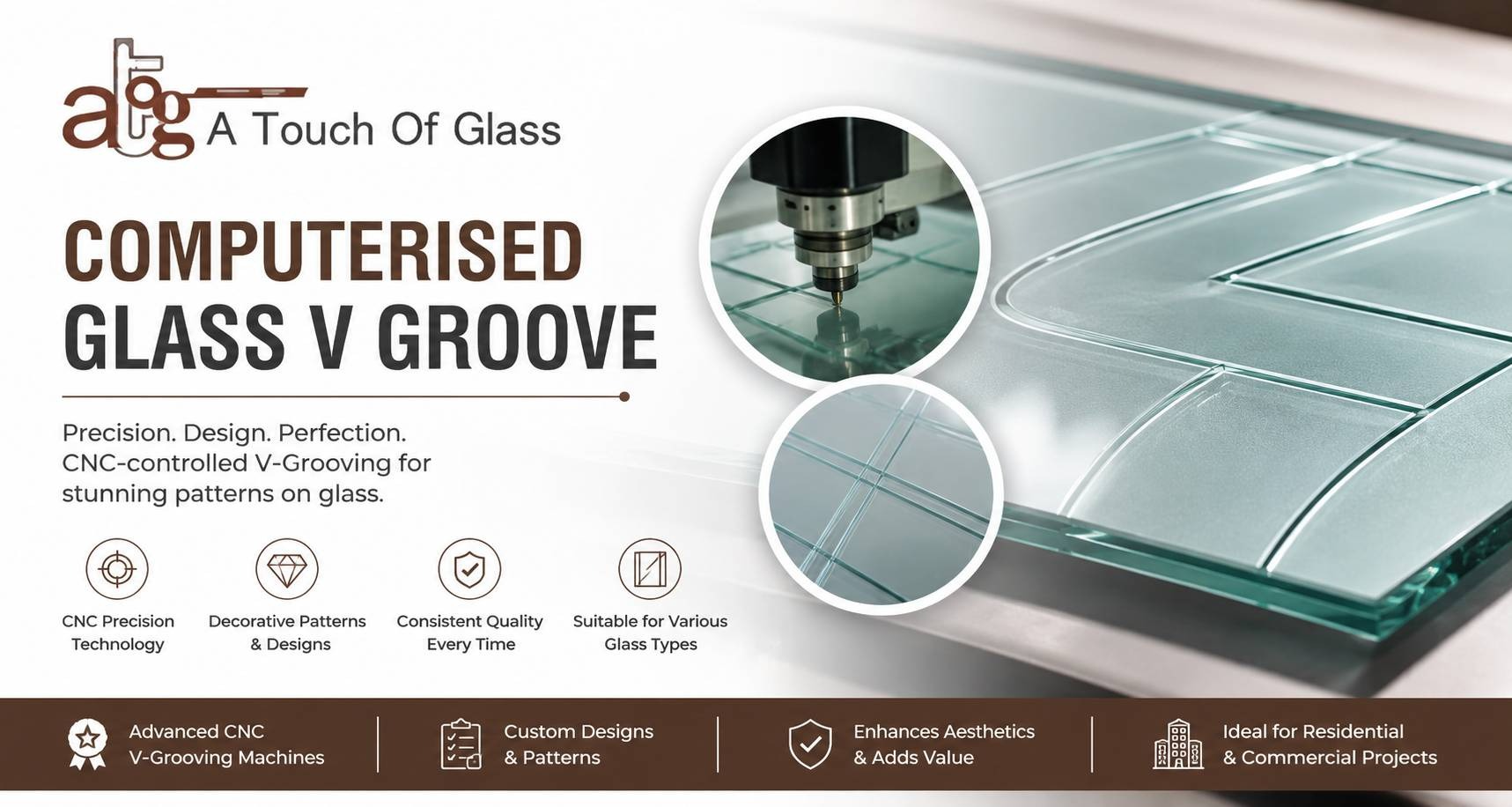
Computerised Glass V Groove is a decorative glass-processing technique where a CNC-controlled machine cuts shallow, V-shaped channels into the surface of flat glass to create linear or curved design patterns. Unlike beveling, which shapes the outer edge of a glass panel, V-grooving is applied anywhere on the glass surface — creating a pattern that catches and bends light as it passes through.
Think of it the way you'd think of routing a groove into wood: a Computerized Glass V-Grooving Machine guides a diamond-tipped tool along a programmed path, cutting a consistent V-shaped channel at a set depth and angle across every panel in the batch.
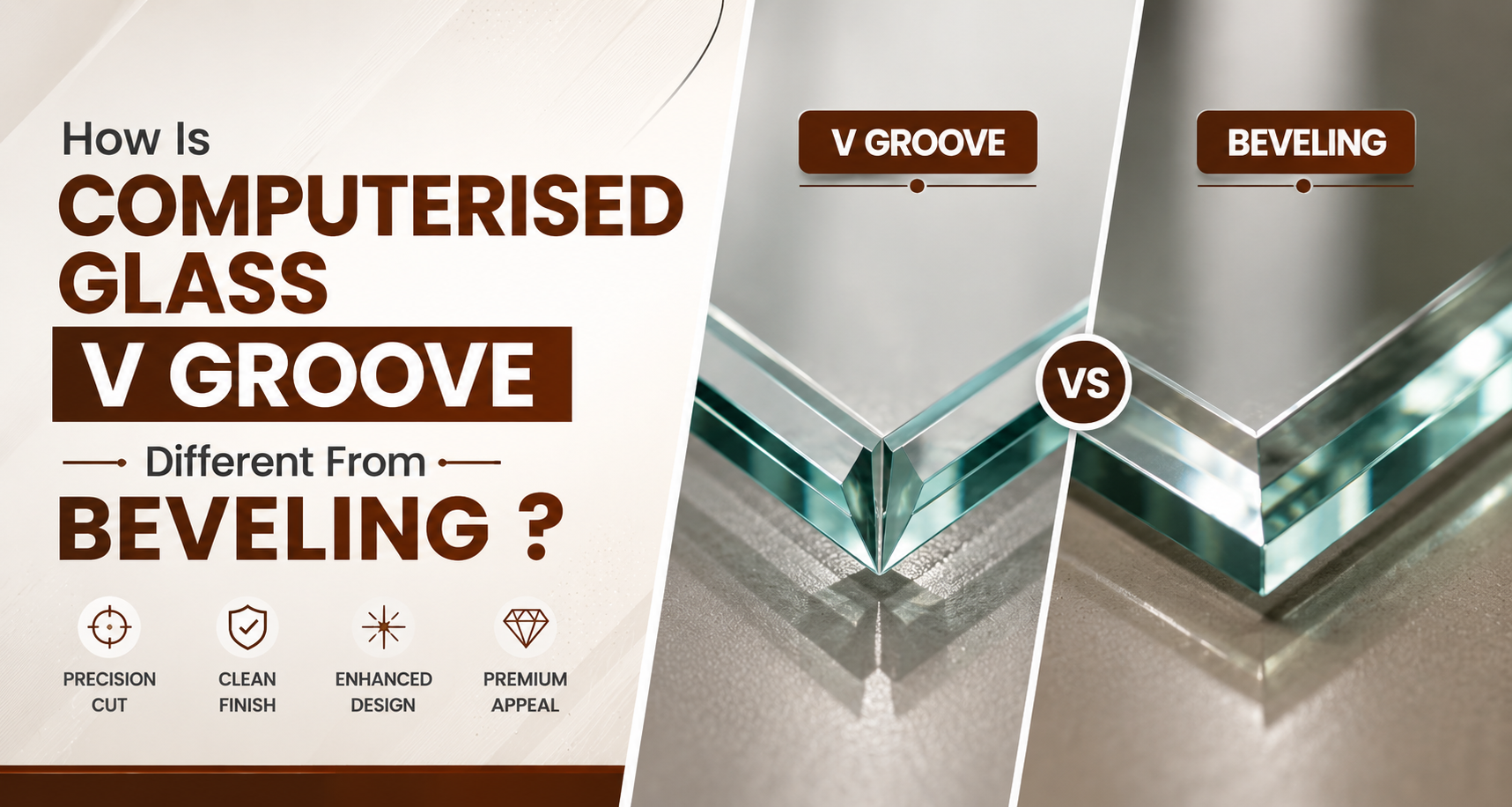
How Is Computerised Glass V Groove Different from Beveling ?
This is one of the most common questions we get, and it deserves a clear, direct answer :
- Beveling cuts an angled slope along the outer perimeter of a glass panel.
- V-grooving cuts a design pattern anywhere on the glass surface — lines, curves, grids, even logos.
Both processes use similar CNC principles, but they solve different design problems. Many of our clients actually combine the two: a beveled edge for the border, with a v-groove pattern running through the body of the panel.
How the Computerised Glass V-Grooving Process Works ?
Here's a simplified, step-by-step look at how a CNC Glass V-Grooving Machine actually produces a finished groove :
- Design input - The groove pattern (straight lines, curves, or a custom design like a logo) is programmed into the machine's CAD-linked controller.
- Glass loading - The float glass sheet is loaded and secured flat on the machine bed.
- Tool selection - A diamond-profiled grinding wheel matching the required groove angle (commonly 90° or 120°, though custom angles are possible) is fitted.
- CNC grooving - The spindle traverses the glass surface along the programmed path, cutting the V-channel to the specified depth, width, and spacing in a single controlled pass.
- Cleaning and finishing - The grooved glass is washed to remove grinding residue; grooves can be left with a frosted, ground texture or polished for a fully clear finish.
- Quality inspection - Groove depth, spacing, and pattern alignment are checked against the design brief before the glass is cleared for dispatch.
This level of control is what an Automatic Glass Beveling Machine's grooving counterpart offers over manual routing — every groove in a multi-panel order comes out matching, run after run.
Why Computerised Glass V Groove Matters ?
Design Versatility
From simple parallel lines to intricate curved motifs or a client's logo, precision glass V-grooving gives designers a level of creative freedom that etching and sandblasting can't match — because the grooves are physically cut into the glass, not just surface-treated.
Light and Visual Depth
As light passes through a v-groove pattern, it refracts along each channel, creating subtle shadow lines and highlights that shift depending on the viewing angle and lighting condition. This is why v-grooved partitions and feature walls feel more dynamic than plain glass, without sacrificing transparency.
Privacy Without Losing Openness
A grooved pattern breaks up direct sightlines just enough to add a sense of privacy — useful in office partitions, conference rooms, and bathroom or shower panels — while keeping the space feeling open and naturally lit.
Consistency at Scale
For projects involving multiple partitions, doors, or feature panels, a Computerized Glass V-Grooving Machine guarantees every groove matches in depth, spacing, and angle. That consistency is nearly impossible to replicate with hand-routing tools once you're working beyond a single custom piece.
Where Computerised Glass V Groove Is Used ?
| Application | Why V-Grooving Helps |
|---|---|
| Office & Corporate Partitions | Adds texture and mild privacy without blocking light. |
| Mirrors | Creates decorative accents and framing patterns. |
| Doors & Windows | Refracts light into distinct linear highlights. |
| Feature Walls & Room Dividers | Adds visual depth to otherwise flat glass surfaces. |
| Retail & Hospitality Interiors | Elevates storefronts and display panels with a premium finish. |
| Custom Signage & Branding | Grooved logos and patterns create a distinctive, high-end appearance. |
V-grooving works well on clear, tinted, frosted, and tempered glass, which means the design can be adapted for both safety-glass requirements and pure decorative applications.
Computerised Glass V Groove vs. Manual Routing
We're often asked whether hand-routed grooving is a cheaper, equally good alternative. In our experience, it depends entirely on the scale and precision the project demands :
- Manual grooving can work for a single, highly artisanal piece where slight variation is part of the charm.
- Computerised Glass V Groove is the only realistic option once you need more than one matching panel, a precise repeating pattern, or tight tolerance on groove depth and spacing.
Most architectural and commercial projects fall firmly into the second category — which is exactly why CNC-based grooving has become the industry standard for anything beyond one-off decorative glass.
Common Mistakes We See in V-Groove Glass Projects
After two decades in glass processing, a few recurring issues stand out :
- Ordering without a sample. Groove depth and spacing look very different under real lighting than on a design mock-up — always request a physical sample panel first.
- Choosing the wrong glass thickness. Thinner glass limits how deep a groove can safely be cut without weakening the panel; this needs to be planned before ordering, not after.
- Overlooking tempering requirements. If the finished glass will be used in a door, partition, or low-level application, it usually needs to be tempered for safety — and grooving should be done before this stage.
- Assuming all grooving machines are equal. Groove consistency depends heavily on machine calibration and operator experience; inconsistent spacing across a batch is one of the most common quality complaints we hear about from other fabricators' work.
Why Choose A Touch of Glass for Computerised Glass V Groove ?
We don't outsource your glass to a third-party workshop and hope it comes back matching your brief. At A Touch of Glass, Kopar Khairane, Navi Mumbai:
- We operate our own Computerised Glass V Groove, bevel, and edge-polish machinery in-house
- We are stockists for Saint Gobain, Modiguard, and HNG float glass brands
- We've processed architectural glass since 2005, led by Mr. Faisal Gandhi, with 20 years of industry expertise
- We support custom groove patterns, widths, and finishes matched to your design brief
- We offer transparent pricing and realistic delivery timelines for both small and large orders
- We also provide Computerised Glass Bevel and Computerised Glass Edge Polish, so your entire glass finishing project can be handled by one team
Whether you're an architect specifying a v-grooved feature wall, a contractor sourcing partitions for an office fit-out, or a homeowner looking for a distinctive mirror design, our approach stays the same: precise, in-house control from design to delivery.
Conclusion : Bring Texture and Light Into Your Glass
Computerised Glass V Groove turns flat, functional glass into a design feature — adding pattern, light play, and a touch of privacy without losing transparency. Getting a clean, consistent result depends on the machine, the operator's calibration, and the quality checks along the way.
If your next project involves partitions, mirrors, doors, or feature panels that could benefit from a v-groove design, A Touch of Glass can help you plan the right pattern and deliver it with true CNC-level precision.
Frequently Asked Questions
Computerised Glass V Groove is a CNC-controlled process that cuts shallow V-shaped channels into the surface of flat glass to create decorative linear or curved patterns. It's produced using a Computerized Glass V-Grooving Machine for consistent depth, spacing, and angle across every panel.
V-grooving cuts a design pattern anywhere on the glass surface, while beveling shapes the angled edge around the glass perimeter. Both use CNC precision machinery, but they solve different design problems and are sometimes combined on the same panel.
Cost depends on the pattern complexity, groove depth and width, glass thickness, glass type, and order volume. Simple linear patterns on standard float glass cost less than intricate custom designs or logos. Contact A Touch of Glass for a project-specific quote.
Yes, but v-grooving should be completed before the tempering process, since cutting into glass after tempering can compromise its structural integrity. Plan the grooving and tempering sequence with your fabricator in advance.
Thicker glass generally supports deeper, more defined grooves without weakening the panel. Very thin glass limits groove depth options, so our team reviews your intended use before recommending a thickness.
A Touch of Glass, located at Kopar Khairane, Navi Mumbai, offers in-house Computerised Glass V Groove, bevel, and edge-polish services for residential and commercial projects across the Mumbai region.