


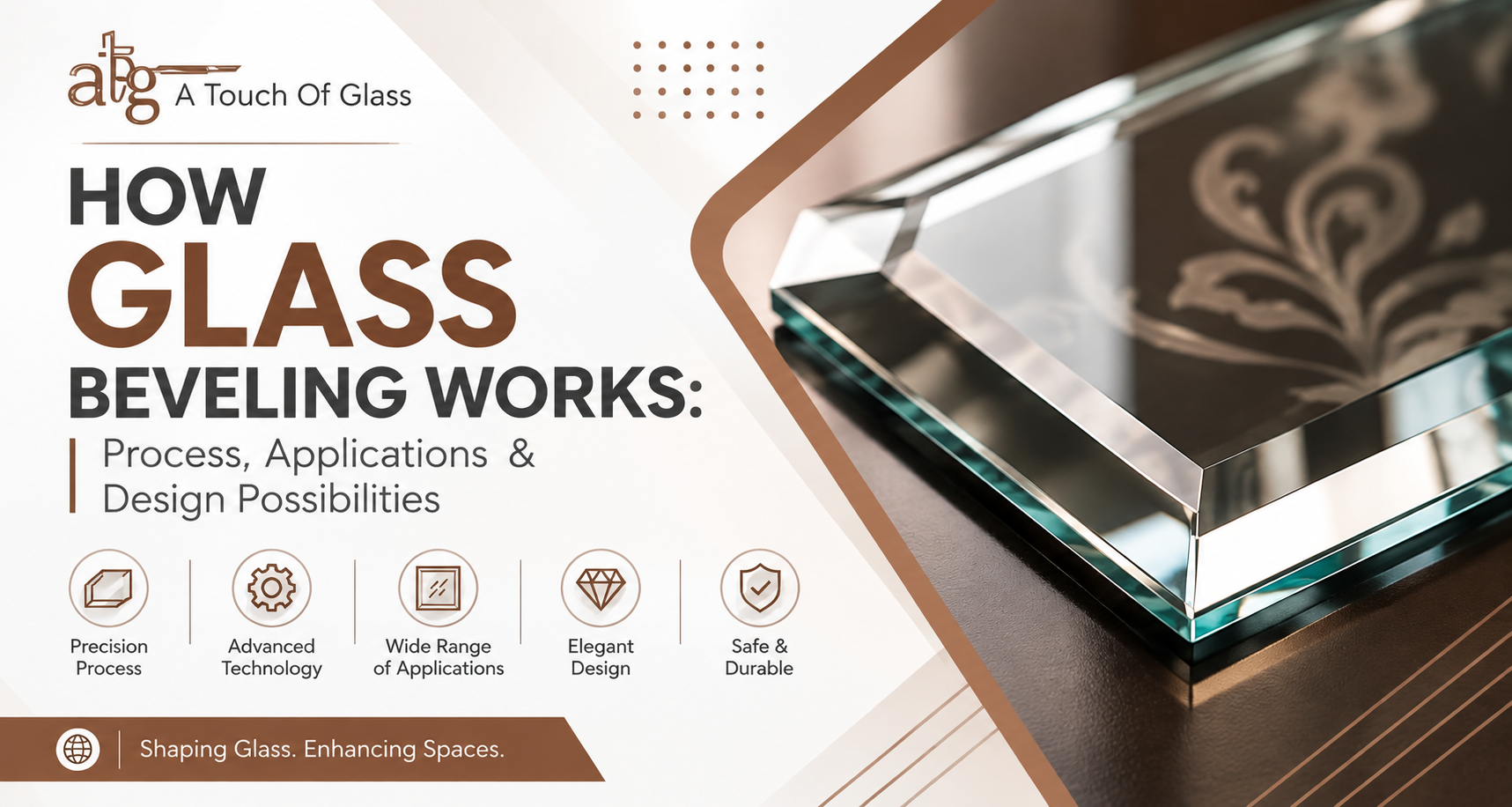
How Glass Beveling Works: Process, Applications & Design Possibilities
Glass is one of the most unforgiving materials to work with. A single hairline crack from a poorly finished edge can turn a beautiful mirror or partition into a safety hazard. That's exactly why the glass beveling process exists — and why getting it right takes more than a grinding wheel and a steady hand.
We're A Touch of Glass, and we've been shaping architectural glass since 2005. Over the past two decades, we've moved from manual edge work to fully computerised glass beveling, and we've seen firsthand how much precision matters — not just for looks, but for durability and safety. In this guide, we'll walk you through exactly how glass beveling works, where it's used, and how to think about it if you're specifying glass for a project.
What Is Glass Beveling?
Glass beveling is the process of cutting and grinding a flat, angled edge along the perimeter of a glass panel, instead of leaving the edge at a straight 90-degree cut. The angled surface catches and refracts light, creating a faceted, prism-like effect while also removing the sharp edge that raw cut glass leaves behind.
Beveled edges typically range from a subtle 1/4-inch bevel used on shower doors to a dramatic 2-inch bevel used on decorative mirrors and glass tabletops. The wider the bevel, the more pronounced the light-catching effect — but wider bevels also demand more precision, since any inconsistency becomes far more visible.
Why Does Glass Beveling Matter?
Beyond the visual upgrade, beveling solves three practical problems that raw-cut glass creates:
- Safety — Removes sharp, splinter-prone edges that can cause cuts during handling or installation
- Durability — A beveled edge is less prone to chipping than a sharp 90-degree edge, which absorbs impact poorly
- Design flexibility — Allows glass to be used decoratively, not just structurally, in mirrors, doors, and furniture
We often tell clients: an unbeveled edge on decorative or handled glass isn't just a design miss — it's a liability waiting to happen.
The Glass Bevel Process, Step by Step
Here's how a glass panel goes from a raw cut sheet to a finished bevel-edged piece.
Step 1: Glass Cutting and Shaping
The panel is first cut to its final size and shape using a glass cutter or CNC cutting table. Accuracy here matters — any deviation in the cut dimensions carries through every later step.
Step 2: Edge Seaming
Before beveling begins, the raw edge is seamed (lightly ground) to remove the sharpest points and reduce the risk of chipping once the piece is loaded onto the beveling machine.
Step 3: Rough Grinding the Bevel Angle
The glass is fed into a beveling machine fitted with diamond or abrasive wheels set at the target bevel angle — commonly between 3 and 15 degrees, depending on the design brief. This stage removes the bulk of the material to establish the angled face.
Step 4: Fine Grinding
Progressively finer abrasive wheels smooth out the rough-ground surface, eliminating visible scratch marks and evening out the width of the bevel along the entire edge.
Step 5: Polishing
The final stage brings the bevel to a clear, glass-like shine using polishing wheels and compounds (often cerium oxide). This is what gives a finished bevel its signature sparkle and light refraction.
Step 6: Inspection
Every edge is checked for uniform bevel width, consistent angle, and a defect-free polished surface before the piece leaves the floor.
Computerised Glass Beveling vs. Manual Beveling
Manual beveling depends entirely on an operator's hand control and experience — which means even skilled technicians introduce small variations from edge to edge. Computerised glass beveling uses CNC-controlled machines to hold the bevel angle, width, and pressure constant across the entire piece and across every piece in a production run.
| Factor | Manual Beveling | Computerised Beveling |
|---|---|---|
| Consistency | Varies by operator | Uniform across every edge |
| Speed | Slower, one piece at a time | Faster, repeatable runs |
| Complex shapes/curves | Difficult | Handled precisely |
| Best suited for | Small one-off repairs | Architectural & production volumes |
At Touch of Glass, our CNC beveling equipment is what lets us guarantee that a 500mm mirror bevel looks identical whether it's the first piece off the line or the fiftieth.
Common Glass Beveling Techniques
- Flat beveling — A single angled facet along the edge; the most common technique for mirrors and tabletops
- Double beveling — Two angled facets meeting at a ridge, used for a more dramatic decorative effect
- Curved (radius) beveling — Bevels applied along curved or irregular edges, requiring CNC precision to keep the angle constant around the curve
- Mitred beveling — Bevels that meet cleanly at corners, common in framed mirrors and glass panel assemblies
Where Is Glass Beveling Used?
Beveled glass shows up far more often than most people realise:
- Mirrors — Decorative wall mirrors, bathroom mirrors, and furniture-integrated mirrors
- Glass partitions and doors — Office partitions and interior doors where a finished edge is both visible and touched
- Tabletops and furniture glass — Dining tables, coffee tables, and display cabinets
- Shower enclosures — Frameless shower doors, where a bevel softens the edge without needing a frame
- Decorative architectural panels — Feature walls, cabinetry inserts, and lighting fixtures
Each application calls for a different bevel width and angle, which is why the design brief matters as much as the machine doing the work.
Design Possibilities With Glass Beveling
Beveling isn't a one-size finish. Some of the design choices we walk clients through include:
- Bevel width — Narrow bevels (6–12mm) for a subtle edge treatment; wide bevels (25mm+) for a strong decorative statement
- Bevel angle — Steeper angles create a more visible facet line; shallower angles blend more smoothly into the glass surface
- Pattern combinations — Beveled borders paired with V-groove detailing or edge polish for a fully custom look
- Glass type and thickness — Bevel proportions typically need to be adjusted for thicker glass (10mm+) versus standard 4–6mm glass
Common Mistakes to Avoid When Specifying Beveled Glass
From two decades of client conversations, these are the mistakes we see most often:
- Choosing a bevel width that's too narrow or wide for the glass thickness, which throws off proportions
- Ignoring edge consistency requirements on large production runs, where manual beveling can't hold tolerance
- Overlooking safety glass requirements — beveled glass used in doors or partitions may still need to be toughened or laminated depending on local building codes
- Skipping a sample panel before committing to a full production run
How Much Does Glass Beveling Cost?
Glass beveling cost depends on the bevel width, glass thickness, edge length, and order volume. Narrow bevels on standard 4–6mm glass are the most economical option, while wide, curved, or double bevels on thicker glass cost more due to the additional grinding and polishing time required. For an accurate quote, it's best to share your glass dimensions, thickness, and desired bevel width directly with a fabricator.
Why Work With Touch of Glass for Computerised Glass Beveling
We've been a trusted name in architectural glass processing since 2005, led by Mr. Faisal Gandhi, who brings 20 years of hands-on industry expertise to every project. What sets our process apart:
- Advanced CNC and automated glass processing technology for consistent, repeatable results
- Skilled technicians who understand how bevel width, angle, and glass thickness interact
- Customised glass finishing tailored to residential, commercial, and architectural design needs
- A track record of on-time delivery across mirror, partition, and façade projects for architects and interior designers
If you're specifying glass for a project — whether it's a single custom mirror or a full architectural glazing package — we can guide you through bevel width, groove depth, and edge polish decisions so the final piece performs as well as it looks.
Conclusion
The glass beveling process turns a sharp, raw-cut edge into a safer, more refined finish — and computerised glass beveling is what makes that finish consistent at any scale. Whether you're working on a single decorative mirror or a full commercial glazing package, understanding the process helps you specify the right bevel width, angle, and technique for your project.
Ready to get a beveled glass edge that's precise every time? Talk to our team about your project specifications, or explore our Computerised Glass Bevel services to see what's possible.
Frequently Asked Questions
The glass beveling process involves cutting glass to size, seaming the raw edge, grinding an angled facet using diamond abrasive wheels, fine-grinding to smooth the surface, and polishing to a clear shine. Computerised machines control the angle and width for consistent results across every piece.
Bevel width depends on the application and glass thickness — narrow bevels (6–12mm) suit standard 4–6mm glass like mirrors and shower doors, while wider bevels (25mm+) work better on thicker glass or statement decorative pieces.
Computerised glass beveling uses CNC-controlled machines to hold a consistent angle, width, and pressure across every edge and every piece in a run, while manual beveling depends on operator skill and can vary from piece to piece.
Yes — beveling removes the sharp 90-degree edge left by raw cutting, reducing the risk of cuts during handling and making the edge less prone to chipping on impact.
Beveled glass is most commonly used in mirrors, glass partitions and doors, tabletops and furniture, frameless shower enclosures, and decorative architectural panels.
Cost depends on bevel width, glass thickness, edge length, and order volume — narrow bevels on standard glass are the most economical, while wide, curved, or double bevels on thicker glass cost more due to added processing time.