


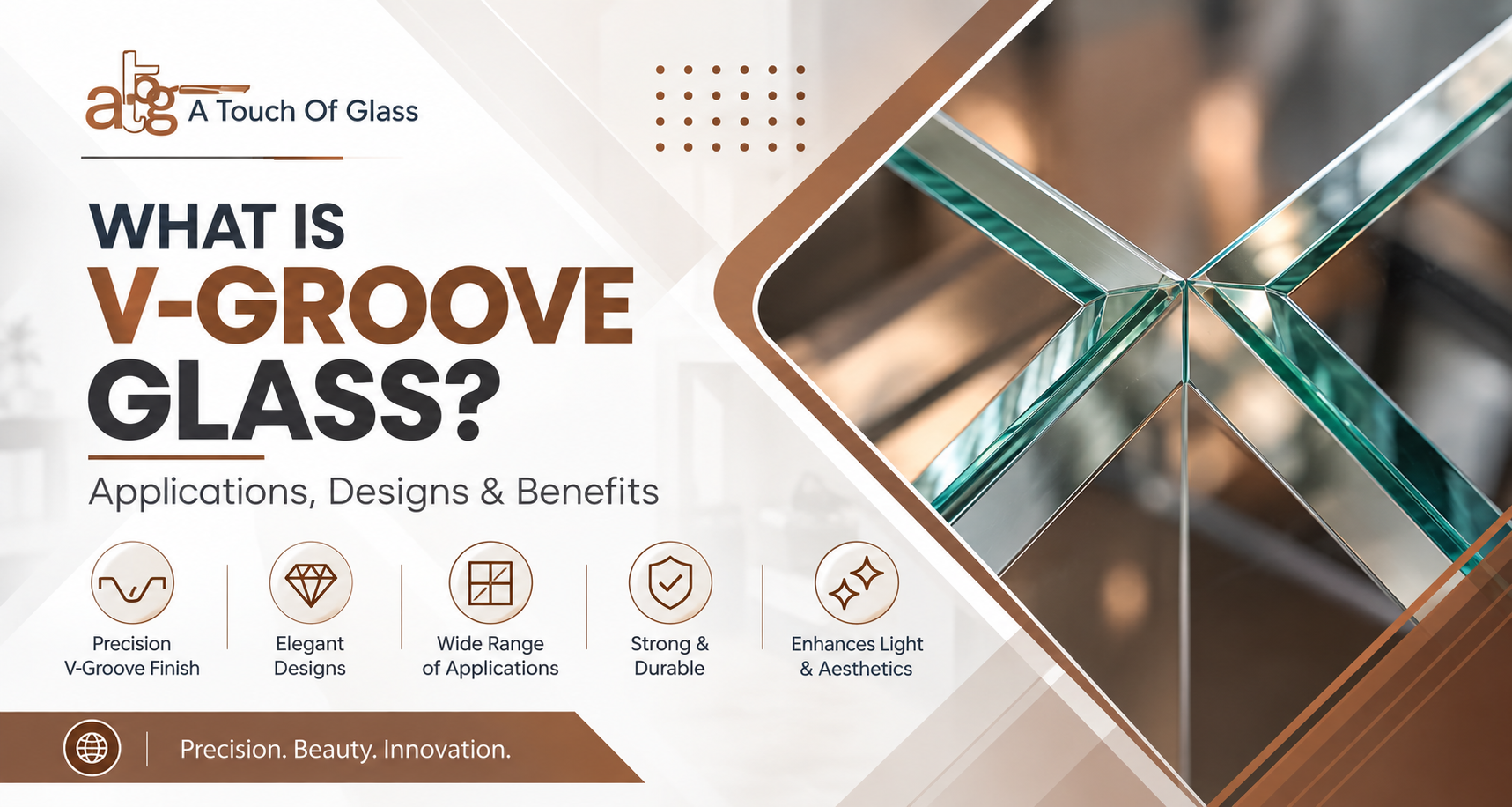
What Is V-Groove Glass? Applications, Designs & Benefits
Not every design detail on a glass panel needs to come from paint, film, or sandblasting. Some of the most striking glass finishes are cut directly into the surface — and that's exactly what V-groove glass does. It's a technique that's been quietly elevating mirrors, partitions, and decorative panels for years, yet most people who walk past a beautifully grooved glass door have no idea how it was made.
We're A Touch of Glass, based in Navi Mumbai, and we've been processing architectural glass since 2005. Our Computerised Glass V Groove service is one of the most requested finishes we offer — and in this guide, we'll explain exactly what V-groove glass is, how it's made, where it's used, and what to consider before you specify it for a project.
What Is V-Groove Glass?
V-groove glass is glass that has had V-shaped channels cut directly into its surface to create a decorative pattern. Unlike beveling, which shapes the edge of the glass, V-grooving works anywhere across the face of the panel — in straight lines, curves, or custom patterns — and the cut lines themselves become part of the design, catching and refracting light as they run across the glass.
It's often compared to routing a design into wood: a diamond-tipped tool carves a precise "V" shaped groove into the glass surface, rather than adding a coating or design on top of it. That's what gives V-groove glass its permanence and its distinctive shadow-and-sparkle effect under light.
How Is V-Groove Glass Made?
Step 1: Design and Digital Layout
The groove pattern — whether a simple linear border or an intricate custom motif — is first drawn up in CAD (computer-aided design) software. This is where groove depth, spacing, width, and angle are all specified before any cutting begins.
Step 2: CNC Machining
The glass panel is loaded onto a computerised glass V-groove machine, where diamond-tipped cutting wheels carve the design directly into the glass surface following the CAD file. Because the machine controls the tool path precisely, complex patterns and curves come out identical every time — something manual grooving simply can't guarantee.
Step 3: Grinding and Finishing
Once the grooves are cut, the surface is ground to remove any rough edges left by the cutting tool. At this stage, we decide whether the groove lines will be left with a frosted, textured finish or ground further to a clear, polished look.
Step 4: Cleaning and Inspection
The finished panel is cleaned and inspected for consistent groove depth and width across the entire pattern before it's approved for installation.
Step 5: Toughening or Laminating (if required)
Depending on where the glass will be used — a door, partition, or balustrade — the grooved panel may still need to go through toughening or lamination for safety compliance, since V-grooving itself doesn't change the glass's structural rating.
V-Groove Glass vs. Other Decorative Techniques
| Technique | How It Works | Best For |
|---|---|---|
| V-Groove | CNC cuts V-shaped channels into the surface | Linear/geometric patterns, borders, logos |
| Sandblasting/Etching | Abrasive or acid treatment frosts the surface | Soft, all-over frosted designs |
| Bevel | Angled cut along the panel edge | Edge detailing on mirrors, tabletops |
| Film/Vinyl | Applied surface layer | Temporary or budget-friendly designs |
The key distinction: V-grooving physically removes glass to create the design, so it won't peel, fade, or wear off the way an applied film can.
Why Choose V-Groove Glass? Key Benefits
- Permanent, durable design — Since the pattern is cut into the glass itself, it doesn't degrade like an applied surface treatment
- Light-catching visual effect — Groove lines refract and reflect light, adding depth and movement to an otherwise flat panel
- Design flexibility — From simple border lines to detailed custom logos, CNC control makes almost any pattern achievable
- Combines well with other finishes — Works alongside bevels, edge polish, or sandblasting for a fully custom panel
- A cost-effective alternative to full custom glass fabrication — Adds a high-end look without the cost of specialty glass
Common Applications of V-Groove Glass
V-groove glass shows up across a wide range of residential and commercial spaces:
- Decorative mirrors — Border patterns and geometric detailing on wall or furniture mirrors
- Glass partitions and office doors — Grooved patterns that add privacy-adjacent texture while keeping the panel transparent
- Cabinetry and furniture glass inserts — Subtle grooved accents on cabinet doors and display units
- Entrance doors and glass panels — Custom logos or brand marks cut directly into commercial entryway glass
- Restoration projects — Recreating period-accurate grooved patterns found in older glass installations
Design Possibilities With V-Groove Glass
When clients come to us for V-groove work, the design conversation usually covers:
- Groove depth and width — Deeper, wider grooves create a bolder shadow effect; shallow grooves give a subtler texture
- Pattern style — Straight linear borders, curved motifs, geometric repeats, or fully custom artwork and logos
- Finish — Frosted/textured grooves for a soft, opaque look, or polished grooves for maximum clarity and sparkle
- Combination finishes — Pairing V-groove borders with a beveled edge or polished perimeter for a layered, premium look
Common Mistakes to Avoid With V-Groove Glass
From our own project experience, these are the issues that come up most often when V-groove work isn't planned properly:
- Placing grooves too close to the panel edge, which weakens the glass and increases the risk of chipping
- Choosing groove depth without considering glass thickness, leading to inconsistent visual results
- Skipping a design proof before committing to a full production run on a custom pattern
- Forgetting safety glass requirements — grooved panels used in doors or partitions may still need toughening or lamination depending on application and local building codes
How Much Does V-Groove Glass Cost?
V-groove glass pricing depends on the complexity of the pattern, the groove depth and length, glass thickness, and whether the design is a stock pattern or fully custom. Simple linear border patterns on standard glass are the most economical option, while intricate custom motifs, logos, or curved designs take longer to program and cut, which increases cost. Sharing your glass dimensions and a rough sketch or reference image with a fabricator is the fastest way to get an accurate quote.
Why Work With Touch of Glass for Computerised Glass V-Groove
We've been a trusted name in architectural glass processing since 2005, led by Mr. Faisal Gandhi, who brings 20 years of hands-on industry expertise to every project. Here's what our clients get:
- Advanced CNC V-groove technology for precise, repeatable patterns across every panel
- Skilled technicians who can guide groove depth, width, and finish decisions based on your glass thickness and application
- Custom pattern capability — from simple borders to detailed logos and motifs
- A track record of reliable, on-time delivery for architects, interior designers, and commercial clients
Whether you're adding a decorative border to a set of office partitions or recreating a heritage pattern for a restoration project, we can walk you through the design and process decisions that get the result you're picturing.
Conclusion
V-groove glass turns a flat, plain panel into a permanent, light-catching design feature — and computerised V-groove technology is what makes intricate, repeatable patterns achievable at scale. Whether you need a subtle linear border or a fully custom motif, understanding the process helps you plan groove depth, pattern, and finish correctly from the start.
Thinking about adding V-groove detailing to your next glass project? Talk to our team about your design, or explore our Computerised Glass V Groove services to see what's possible.
Frequently Asked Questions
V-groove glass is glass that has had V-shaped channels cut directly into its surface using diamond-tipped tools, creating a permanent decorative pattern that catches and refracts light — unlike surface treatments such as film or paint.
V-groove glass is made by first designing the pattern in CAD software, then cutting it into the glass surface with a CNC machine fitted with diamond-tipped cutters, followed by grinding, finishing, and cleaning the panel.
V-grooving physically cuts channels into the glass surface, while etching or sandblasting frosts the surface using abrasive or acid treatment without cutting into it — V-groove lines are typically more defined and dimensional.
V-groove glass is commonly used on decorative mirrors, glass partitions and office doors, cabinetry inserts, entrance doors and logo panels, and in restoration projects recreating period glass patterns.
Yes — since the design is programmed through CAD software and cut by CNC machine, custom logos, motifs, and intricate patterns can be cut into the glass alongside standard linear or geometric designs.
V-groove glass cost depends on pattern complexity, groove depth and length, glass thickness, and whether the design is a stock or custom pattern — simple linear borders are the most affordable, while detailed custom motifs cost more.